P-09-0715
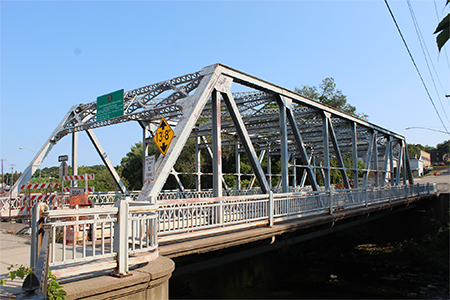
WisDOT Designation: Local – County-owned
Current Owner: City of Chippewa Falls
Year Built: 1938
County: Chippewa County
Crossing: Duncan Creek
Bridge Category: Riveted, Pratt overhead
Spans and Type: 1 span, overhead truss
Overall Length and Width: 130 feet x 49 feet
National Register of Historic Places Status: Determined Eligible for listing in the National Register
Details
The downtown bridge supports two-way traffic and carries Central Street over Duncan Creek north of the confluence with the Chippewa River. The bridge is a steel, riveted, Pratt overhead truss and includes sidewalks on both sides that are enclosed with ornamental cast steel railings with curved ends. The bridge has a 6-inch concrete deck that has been overlayed with asphalt. The deck rests on 14 I-beam stringers supported by concrete abutments – eight of the stringers support the roadway and six support the sidewalks. The stringers are intersected by nine floor beams and laterally braced with cross-bracing that is riveted to the bottom chord.
Steel overhanging brackets extend from the floor beams to support the sidewalks. The bottom chord is built of back-to-back channels riveted with batten plates. The top chord has inclined end posts and is constructed of two channels with a top plate and underside lattice lacing. The top chords are connected with lateral cross-bracing and supported by lateral struts with sway bracing. The portals are constructed of angles with topside V-lacing and connected to the lattice bracing by gusset plates.
History
Chippewa Falls was incorporated as a city in 1869. In 1874, an iron bridge was constructed on Central Street over Duncan Creek. On March 27, 1880, a devastating flood of Duncan Creek destroyed several Bridges and two dams and caused damage to several properties. The Central Street Bridge was swept away in the flood. A wood plank bridge was constructed in its place, and it was later replaced with a steel bridge in 1894. In April 1934, Duncan Creek flooded again and caused an estimated $500,000 worth of damage throughout Chippewa County. Highway officials reported that between 20 and 25 bridges had been washed away by the flood, including the steel bridge on Central Street.
In May 1934, plans for reconstruction began after federal funding was approved for the majority of the work. Despite a lot of early progress, substantial work did not begin until fall 1938. The bridge was largely completed by the end of 1938, with painting work being completed in May 1939.