ATV Route Signing

ATV route sign permitting
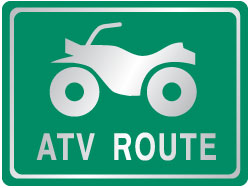
ATV route signATV route signs are required on state highways in order for ATVs to legally operate on them. A traffic signing permit is also required from WisDOT. The application form may be filled out by a local government elected official or employee, or a county highway department may fill it out for the local government. Send the completed permit application to the transportation region office along with a copy of the approved ATV ordinance(s).

Find a transportation region office

The permit application must include a map or sketch showing the general location of the signs. Once approved, the permittee orders the signs and related materials. County highway departments typically install signs on state highways since they have expertise with the Wisconsin Manual of Uniform Traffic Control Devices (WMUTCD) and install many WisDOT signs. A municipality may install the signs or hire a licensed contractor with WMUTCD expertise upon prior WisDOT approval. All signs erected must comply with the WMUTCD.

Special ATV route signing
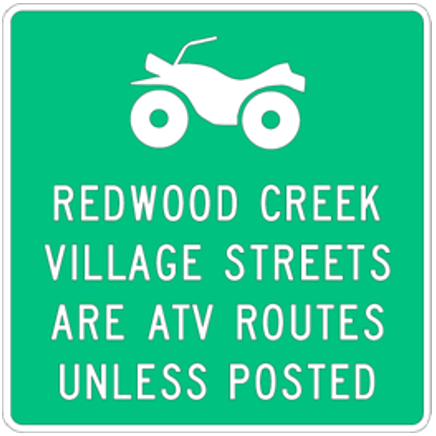
D11-10A ATV signUnder Wis. Stat. s. 23.33(8)(e)3., a town, village, city or county may erect a sign on any highway that crosses its territorial boundary to alert motorists that all highways under its jurisdiction have been designated as ATV routes. On state highways, WisDOT approval is not needed, but a traffic signing permit is still required. The D11-10A sign — similar to the one shown on the left — may be used. The sign size on state highways is 36" x 36." WisDOT will review a town, village, city or county ATV ordinance to verify that it has designated all of its roads as ATV routes prior to granting permit approval to erect the sign on a state highway.
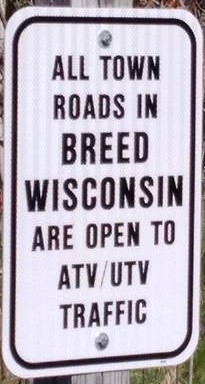
D11-10A local road signSmaller sign sizes may be used on local highways. A white sign with black letters (regulatory sign) may also be used as shown on the right. Consult the person in charge of road maintenance or a county highway department for more information on local road signing.

It is important to understand that these signs only apply to town, village, city or county roads under its jurisdiction — not all roads within a municipality or county. For example, a sign with the message, “ALL ADAMS COUNTY ROADS ARE ATV ROUTES EXCEPT AS POSTED," only applies to county-maintained roads — not all town, village or city roads located within Adams County. ATV routes within those jurisdictions would require separate signing at their boundaries. No ATV Traffic word sign
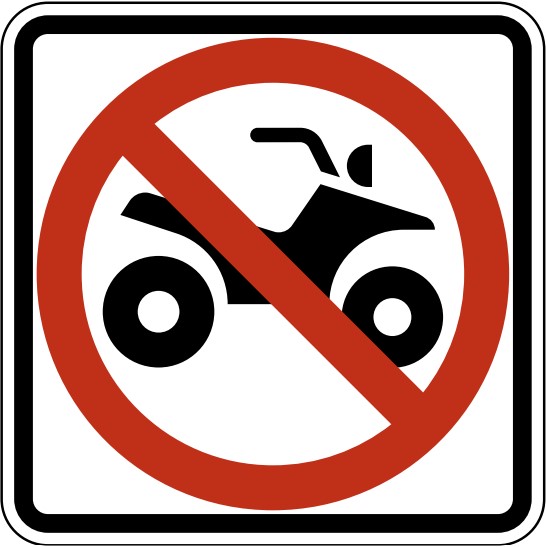
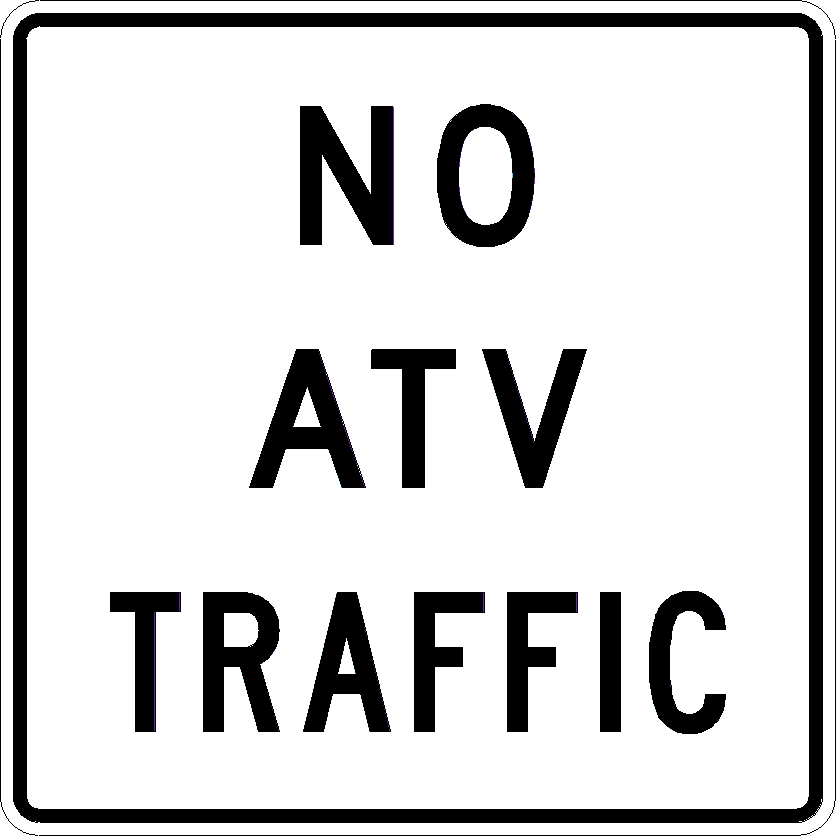
If the D11-10A sign is used, a "NO ATV TRAFFIC" sign (R5-51) may be displayed on any highway where ATVs are prohibited. Since it is a regulatory function, a white sign with black letters must be used. An example is shown on the right. The size on state highways is 24" x 24."
No ATV Traffic symbol sign R9-16Note: The R9-16 sign shown on the left was recently approved for use in the Federal MUTCD on 12/19/23. WisDOT is reviewing the updated MUTCD to determine which revisions will also be implemented
into WisDOT's MUTCD. At this time, however, the sign cannot be used on Wisconsin highways.


ATV route signing - Frequently asked questions

WisDOT has received many questions regarding ATV route signing both on state and local highways. To guide local units of government and ATV clubs on appropriate ATV route signing, this “frequently asked questions” webpage has been established. As more questions are asked of WisDOT, the questions and answers will be posted.

Yes, the WMUTCD must be followed on all state and local highways. Per Wis. Stat. s. 349.065, local authorities shall place and maintain traffic control devices upon highways under their jurisdiction to regulate, warn, guide or inform traffic. The design, installation and operation or use of new traffic control devices placed and maintained by local authorities after the adoption of the uniform traffic control devices manual under Wis. Stat. s. 84.02(4)(e) shall conform to the manual. After January 1, 1977, all traffic control devices placed and maintained by local authorities shall conform to the manual.

It provides consistency for all motorists that travel on all highways throughout the United States. Homemade signs may be hard to read or confuse some motorists. Most importantly, these signs may not be deemed as official if their validity was challenged in court.

Improper homemade No ATV/UTV route sign Improper homemade ATV route sign

No. Neither one of these signs is recognized in the WMUTCD. Only the D11-10 sign in (3) may be used. It is also applicable to UTVs.

(1)
Improper ATV/UTV Route sign
(2)
Improper ATV/UTV route symbol sign
(3)
Proper ATV route sign

No. It must be on a separate post. No other sign should interfere with the regulatory importance of a STOP sign. Mount ATV route signs on their own post — not on an existing sign post, utility pole, fence post, etc.

Yes. See the diagram below.

Improper ATV route and STOP sign placement diagram


150 feet. See the diagram below.

Proper ATV route and STOP sign placement diagram

For questions 7-9, see the diagrams in Figure 2A-2 below (amended from the Federal MUTCD).

Examples of Heights and lateral locations of sign installations

In the picture below, the ATV route sign is placed too low and may pose a hazard if struck by an errant vehicle or motorcycle. The sign must also be placed on its own post.

Weight Limit sign

(1)
Improper ATV speed limit symbol sign greel letters on white background
(2)
Improper ATV speed limit sign using symbols
(3)
Improper ATV speed limit sign using sybmols
(4)
Proper ATV speed limit sign

No for questions 10 and 11. The ATV symbol is only recognized in the WMUTCD for guide signs (white lettering on a green background). A speed limit sign is a regulatory sign. It must have black lettering on a white background. The correct design for an ATV speed limit sign is (4) above.


Near the border. Under Wis. Stat. s. 23.33(8)(e)3., “[a] town, village, city, or county may erect a sign on each highway that crosses its territorial boundary in a position to be viewed by motorists as they enter the town, village, city, or county.”

Maybe. The maintaining authority of the highway decides who erects ATV route signs on its roads.

On state highways, yes. The WisDOT region office will issue the permit. On municipal and county highways, contact the maintaining authority of the highway.

white on green up arrow

While an ATV route sign in addition to the up arrow is preferred, on local highways the up arrow by itself would be adequate. On a state highway, the arrow cannot be by itself.

Yes. Select any of the examples below.
Example 1 - Bridge crossing
Example 2 - 35 mph speed limit or less and D11-10A signing
Example 3 - Bridge crossing, 35 mph speed limit or less, and D11-10A signing
Example 4 - Close-up of Example 3


ATV route PREFERRED sign white on greenWis. Stat. s. 23.33(8)(e)5. allows a municipality or county to designate a preferred route and erect signs marking the route over highways under their jurisdiction that have been designated as ATV routes.

Yes, if installed in accordance with the MUTCD. The WMUTCD did not change the language from the Federal MUTCD. From Section 2A.19, Paragraph 2: "Post-mounted sign and object marker supports shall be crashworthy (breakaway, yielding, or shielded with a longitudinal barrier or crash cushion) if within the clear zone."

Section 1A.13 of the MUTCD defines crashworthy: "Crashworthy—a characteristic of a roadside appurtenance that has been successfully crash tested in accordance with a national standard such as the National Cooperative Highway Research Program Report 350, “Recommended Procedures for the Safety Performance Evaluation of Highway Features.”

FHWA has issued eligibility letters for sign supports that have passed National Cooperative Highway Research Program Report 350 (NCHRP 350). These letters may be found at this link.

On January 1, 2020, NCHRP 350 was superseded by the Manual for Assessing Roadside Hardware (MASH). FHWA is issuing eligibility letters for sign supports that pass MASH. These letters may be found at this link. There are only two letters currently published there. WisDOT's understanding is that both perforated square steel tube post and U-channel posts have passed MASH, and that FHWA just needs to get the letters written and published.

No. A municipality or county has the authority to impose hours of operation and speed restrictions in their ordinance. However, those restriction messages, if used, should be posted on supplemental signs using the correct regulatory color scheme - black letters on a white background. They cannot be included on a D11-10 (left) or D11-10A sign (center). Generally, guide signs and regulatory signs should be on separate posts. In this case, it may be better to place the hours’ restrictions underneath the D11-10 sign as a plaque, but still black-on-white so it is regulatory like the example (right). The ATV speed limit sign shown in question 11 #(4) may be on a separate post to the right of these signs.

Improper combination ATV route and speed limit sign Improper D11-10A sign with hours of operation Proper ATV route sign with separate black on white hours of operation sign

No. That particular sign is not allowed in the WMUTCD. However, a white sign with black letters (regulatory sign) could be made without the symbols as shown in (2).

(1)Improper D11-10A sign to include snowmobile routes
(2)Proper black on white regulatory sign to combine ATV and snowmobile routes

Yes to both situations. This is similar to question 5 only the ATV sign is facing the opposite direction.

(1)Advanced warning STOP ahead signs placed on both sides of the road
(2)ATV route sign placed near and on the back side of a STOP sign
(3)ATV route sign placed near and on the back side of a STOP sign

On top as in (2) and not in combination as in (3). Also, the MK4-6 sign is "END" not "ENDS."

(1)
Improper ATV route and END sign
(2)
Proper ATV route and END sign
(3)
Improper ATV route and END sign

You would need to erect the MK4-6 sign and the D11-10 sign as shown in question 22 #(2).

No. However, if ATVs are operating on the non-designated highway, NO ATV TRAFFIC signs should be erected. This is referenced in Wis. Stat. s. 23.33(8)(e)4.

Wis. Stat. s. 23.33(8)(e) was developed to allow a municipality or county to erect a sign on each highway that crosses its territorial boundary to alert motorists that all highways in the municipality or county have been designated as ATV routes. If D11-10 signs are erected, then a municipality or county does not have to erect signs on all ATV routes as required in subd. 2. Subd. 6., however, does not refer to the R5-51, which is a regulatory sign prohibiting ATV operation. In addition, "the department" refers to the Department of Natural Resources, not a county highway department (CHD). Since the CHD has jurisdiction over the county highways it maintains, it may require R5-51 signs on those highways.

No. Wis. Stat. s. 23.33(8)(e)3., states "may," which is not mandatory. If a municipality has designated all roads under its jurisdiction as ATV routes, the municipality has the option to erect D11-10A signs only on those municipal roads:

3. If a town, village, city, or county designates all highways under its jurisdiction as all-terrain vehicle routes under par. (b)2., the town, village, city, or county may erect a sign on each highway that crosses its territorial boundary in a position to be viewed by motorists as they enter the town, village, city, or county. The signs shall alert motorists that all highways under the jurisdiction of the town, village, city, or county have been designated as all-terrain vehicle routes.


Yes. D11-10A signs may be used when a municipality designates all roads/streets under its jurisdiction (maintained by the municipality) as ATV routes under Wis. Stat. s. 23.33(8)(b)2., and these signs are placed at or near their boundaries. D11-10 signs are required to denote the 35 MPH (or less) zone limits for ATV operation on a state highway under Wis. Stat. s. 23.33(11)(am)4. See this diagram for two signing examples.

No. Only signs that are for guidance and warning of traffic are allowed within highway right-of-way under Wis. Stat. s. 86.19(1) Therefore, sponsorship signs placed next to ATV route signs would be prohibited and subject to removal.